Dirt roads are the borderland between flourishing nature and the black sterility of asphalt roads. Gravel roads are dirt roads after they have been improved with crushed stone to make them more resilient to wear and weather. Dirt roads of all kinds are the roots of rural life.
 Dirt roads are the rule in poor corners and countries, and road maintenance crews are rare so travelers must use their own ingenuity to conquer the problem of a wash-out after a heavy storm. I remember a journey in the back of a truck with Lani tribesmen in the Highlands of West Papua where a new stream formed by an overnight storm carved a deep crevasse in mud across our route. There was no going round or back so we scouted for a pair of logs to lay over the six foot gap the exact distance between the wheels, and then very gently roll the truck across to firm ground on the other side. For local folk it was a minor annoyance compared to the trials of their day, but I doubt many Westerners would have gotten through without their cell phone.
I believe there is more romance driving on dirt than on tar because you never know what you may encounter or, sometimes, even know where the road will end. For sure, there will be potholes and more wildlife on the way, and in rural America you might not realize when the public road changes to a private driveway until you reach a ranch or mobile home where only invited guests are welcome.
Driving on dirt or gravel in summer is musical, except in the desert, because life still clings to the ground instead of buried under poisonous tar. As the tires are steered along the paired track, stalks of vegetation in the center play a random tune on the underside of the vehicle. The lower its frame to the ground the bigger the orchestra.
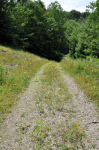
I was musing about the profile of a gravel road I know, and why they all look like a Mohican hair-cut with a mid-line sprout separating bald patches on each side.
Why the difference between the green and the gray? Does it need regular traffic to stay that way? The example I was looking at was an old driveway where road and foot traffic passes infrequently, yet it still had two bald lanes running in parallel. It seems that where there’s been a history of traffic the vegetation is suppressed for a long time, maybe even for centuries. That’s why you can still see some places in the Plains where wagon trains went out West, and old logging trails are visible in the forests of Appalachia.
Another explanation for the difference is drainage because the grassy center probably retains more rainwater than the smooth camber where it runs off quickly. That maybe so, but it doesn’t explain how the difference started in the first place. Besides, I found a flattened area where vehicles used to turn all over the place and it was bald, apart from a few miniature patches of grass where growth had stalled.
The real explanation now seems obvious, especially to a gardener who avoids trampling the ground and keeps the soil particles loose with a fork and hoe. For even if a road is no longer taken, over its history the weight of passing traffic compresses dirt and stones under the wheels, but rarely on the crown of the road which stays more porous so plants can put down roots to reserves of water and oxygen in the gaps. Dirt roads are truly about roots and routes.