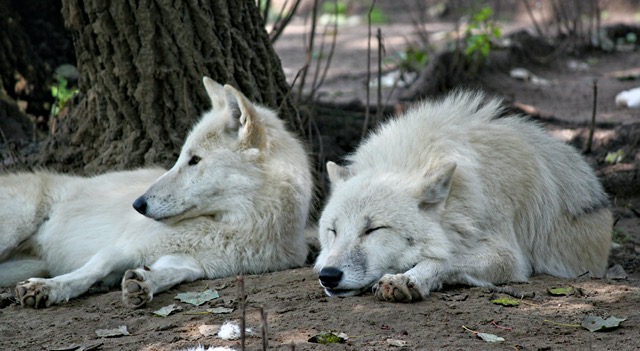
At dawn in Yellowstone’s Lamar Valley I had my first and only glimpse of a pack of wild grey wolves, but they always loomed large in imagination. I follow them in books and movies, read about their conservation and reintroduction, and in a more contemplative mood see their shadow in my pets.
We hold ambiguous attitudes. We created stories of them as evil predators but also learned they are faithful mates and parents. One of the enduring myths is that a pack is ruled by an alpha male and female.
The notion of a pecking order in social animals began with chickens! Such an appealing theory, the biologist Rudolf Schenkel adopted it back in 1947 to explain the hierarchy he observed among ten wolves cooped up in an enclosure at Basel Zoo.
Human societies organize vertically according to rank or class and historical upheavals trying to level differences to the horizontal never lasted long. I experienced the bottom of the pecking order in the school playground as a new boy tortured on the ‘bars’ (iron railings) by bullies who hazed/ initiated us. The great ethologist Konrad Lorenz in seeking to understand human aggression projected it forward from the behavior of animals, although I wonder if we misinterpret animals by extrapolating backwards from our behavior!
Animals, it is said, avoid inevitable conflicts of a homogeneous society by creating social ranks, disturbed occasionally by a strong rival for the alpha post. But this attractive theory fails the test of wilderness evidence in wolves, although even experts find it hard to break the habit of referring to alphas in a pack.
Dave Mech is a world expert who has studied wolves for decades. In Ellesmere Island in the Canadian high arctic he got on intimate terms with them where they are fearless of humans. He learned a wolf pack is not an assorted mix of related and unrelated animals, as in captivity. Each is a family consisting of a monogamous pair of adults and their pups, sometimes with adolescents tagging along. Since we don’t regard our parents as alpha adults, neither should we think of wolves in that way.
The dark side of the error of believing that pack leaders violently rule over subordinates is when it is applied to the training of dogs. Owners who harshly punish pets for disobedience or insubordination may achieve their goal by intimidation, but at what price? Much better and more faithful to what we now know from wolves, we should be head of the family, Mom and Pop to our pups. Likewise, professional trainers today prefer to reward dogs for being a good boy or girl through positive reinforcement (operant conditioning).
Studies in Norther America and Europe should have packed off the creaking theory. But in biology there always exceptions, and not just those unhappy creatures in a cage. Evidently, pecking orders can exist in unusually large packs and maybe I saw a spectrum from alpha to omega when the morning mist cleared over the Lamar River.
Next Post: Downy Woodpecker


