
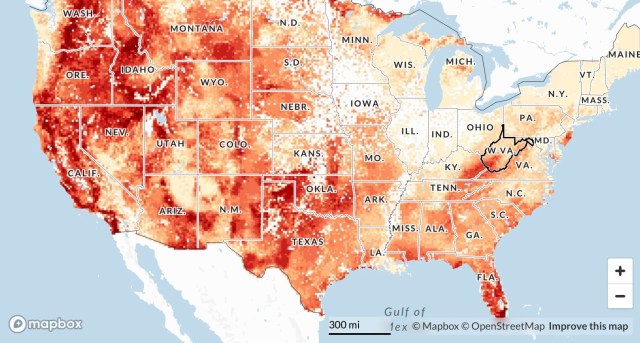
Wildfires are mainly a problem for Westerners, aren’t they? Hardly! The USDA Forest Service’s wildfire risk map shows Southern California is a persistent hot spot. Our friends’ home in Altadena survived the Eaton Fire earlier this year, and few homes were as lucky in the Palisades. But the danger doesn’t end there—states to the north and east, as far as Texas and Oklahoma, now face growing risks.
The reasons vary. In some places, it’s the urban–wildland interface pressing against expanding suburbs. In others, dense forests, dry brush, and parched grasslands create tinderbox conditions, especially when strong winds sweep through. Rising temperatures and prolonged droughts driven by climate change only add fuel to the flames.
Easterners can no longer afford to be complacent. Florida, New Jersey, and the Appalachian Mountains—especially in Kentucky and West Virginia—are increasingly vulnerable, though for different reasons.
Our own home in the Allegheny Mountains offers little defense against fire. The tin roof might help, but the house itself is mostly wood, standing in a small clearing surrounded by a forest of mixed hardwoods and red spruce. Rotting logs and fallen leaves carpet the ground. There’s just one escape route by vehicle—a long, snaking driveway that winds through the woods to a country road.
You might wonder if we sleep easily at night after watching wildfire news from elsewhere. Strangely, we do. Neighbors reassure us that “a fire won’t go far here—the forest floor stays moist.” But the present is not a simple extrapolation of the past. The landscape is not the same as before the great logging boom that ended a century ago, and the climate is changing fast.
We see many signs: invasive plants pushing into higher elevations; winters that once guaranteed deep snow from November to March now fickle and shorter; creeks and springs that ran year-round now dry by late summer. With little rainfall since midsummer (a repeat of last year), wells across the valley have gone dry, so homeowners must truck in water to refill underground tanks.
Meanwhile, from the comfort of a White House or the manicured greens of a golf course, the “Commentator-in-Chief on Climate” calls global warming “the greatest con-job ever perpetrated on the world.” Science and our perceptions are denied again. Ho hum.








 Roger musing about Peace with Nature
Roger, I’m not convinced by the argument that because the forest floor is too moist, a fire won’t go far. Here in Australia we see fires jumping through the canopy where eucalyptus oils provide ready fuel, and I imagine your spruce trees may behave similarly. Clearings around properties may not always be effective when flames and sparks are fanned by strong winds. Two common causes here are lightning strike, and, sadly, arson; both are impossible to prevent.
We live in a high-risk fire area and cannot defend so have a fire plan: leave home early on days with extreme/catastrophic risk (we use an alert system) and a list of what to take with us and which escape routes to use. In 2009 we had terrible fires which came to within about 5 miles of our home on a 113F windy day and were likely only spared due to a change in wind direction. Homes and lives were lost. Since then I dread fire season and hope we never need to use our plan.
I wonder if the ‘Commentator-in-Chief’ truly understands the impact of a fire – did he visit California? Or does he just not care?
LikeLike
Dear Jenny. Thanks so much for sharing your alarming personal story. I remember reading Aussie news that year. I imagine combustible eucalyptus exploding with fiery oil, and shudder to think not only of the property losses but the tragic deaths of wildlife that have no emergency plan. I had no idea you are living on the “edge” and guess the only reason you stay is love of home. As for our moist woods providing some protection, that was advice we received when we moved to the Allegheny mountains. If you hiked with me up Middle Mountain behind our home, jumping over streams and logs into mud and clambering over moss festooned rocks, you would understand our neighbours’ complacency, but considering the drier summers from a changing climate, your intuition may be correct. We need a fire drill because the phone service is feeble
and we can’t holler warnings loud enough to alert the next dwelling over a mile away.
LikeLike